 Horton has befriended my Monty Python "Rabbit with Big Pointy Teeth" bunny slippers. I fear they are plotting against me. I always took comfort in the fact that Horton only has small pointy teeth to kill me with... but apparently he's recruiting.
Friday, March 18, 2011
Vicious Pals
Horton has befriended my Monty Python "Rabbit with Big Pointy Teeth" bunny slippers. I fear they are plotting against me. I always took comfort in the fact that Horton only has small pointy teeth to kill me with... but apparently he's recruiting.

Wednesday, March 16, 2011
What's for Dinner - Steak, roasted veggies, and garlic mashed taters
This was my second-ever attempt to cook a real steak by any other method than "George Foreman Grill", and I was nervous that I would ruin it completely. I bought nice steaks, ribeyes, at about $7 each on sale, and I shuddered to think of the wasted money if I overcooked them. I mean, we'd have eaten them anyway but it would have been a sad waste of a tasty hunk of meat.
I took them out of their packages, rubbed them with salt and pepper, and allowed them to come to room temperature (per cookbook and Food Network instructions) while defending them from feline attack. Meanwhile, I cut up a green pepper, a red pepper, and half a red onion, tossed them with olive oil and a dash of Mrs Dash Original Blend, and put them on a cookie sheet in the oven at 375. I checked them and tossed them every 5 minutes until they looked properly roasty and weren't raw-crunchy anymore. It took about 20 minutes for me, but the size of the chunks will affect the cooking time. Smaller is faster.

I peeled and chopped 6 small potatoes and boiled them until they were soft. At the same time, I warmed up a cup of milk in a pot, after adding two big garlic cloves, peeled and smashed flat. I also added some pepper, mostly because it looked too white. I moved the drained potatoes (and some thick slivers of butter) to a plastic mixing bowl and used my hand mixer to whip them, slowly adding the garlic milk (take the garlic cloves out!) until it was the right consistency. I didn't end up needing the whole cup of milk, but it's always safer to have more than you need. Next time I'll just put the butter in with the milk and let it melt, because I had little butter chunks left in the potatoes. The garlic level of these potatoes was exactly right for me, but I think maybe the addition of smashed roasted garlic would enhance them.
For my steaks, I just plopped them into a very hot, buttery frying pan and left them for about 5 minutes before flipping them and leaving them there for another little while.
 I'm not sure exactly how long I cooked them, because I kept thinking I needed one more minute. It's very hard for me to tell when they're done enough and not overdone. These ended up on the medium-to-medium-well side, and I would have preferred them not quite as done, but they were still very tasty. Next time I'll just use the cooking times suggested in my cookbooks for various levels of doneness and stop doubting them. They just never seem long enough to me, and the steaks don't seem to be cooked enough when my time is up. Maybe it will be good for me to just follow instructions completely for once!
I'm learning. Slowly. I will master steaks eventually.
Sunday, March 13, 2011
Jen's Library - The Happiness Project
The Happiness Project - Or, Why I Spent a Year Trying to Sing in the Morning, Clean My Closets, Fight Right, Read Aristotle, and Generally Have More Fun.
By Gretchen Rubin
This one wins the "longest subtitle" award for sure.
This is a look at one woman's year-long attempt to become happier in all areas of her life. It doesn't pretend to be a self-help book with all the answers to make you happier; in fact, she comes out at the start and says you shouldn't expect the things that worked for her to work for you. It's her story and she's telling it for herself, and maybe it'll help a few people along the way.
It's really hard to give a good overview of the book because it's got a lot of information in it. I'd almost end up rewriting the whole book here in order to cover all of it, so this review is going to end up being more about my response to the book, than the book itself, but I honestly recommend picking it up, because it's interesting and well-written and you may have a light bulb go off while you're reading.
To start the project, the author did a lot of reading on the subject of happiness and found certain ideas or principles she wanted to try and apply to her life, and in this memoir she attacks one aspect of happiness every month. Things like "energy" and "money" and "relationships" and "mindfulness". Not everything works well; in fact, some strategies or ideas piss her off and she drops them pretty quickly - you have no idea how relieved I was to discover someone else who just doesn't get why yoga is so awesome! It all boils down to figuring out what will make you happy and making sure you find ways get to it and fit it into your life.
That's something that resonates with me - feeling like you're supposed to like something. I feel like I'm supposed to want to throw fancy parties, and I feel guilty about preferring a night on the couch with my husband or some friends, enjoying pizza and Wii bowling. I find myself wishing I had more occasions to wear a dress and fancy heels, but in reality, fancy-schmancy restaurants make me feel out of place. I wish I loved a fancy life, I wish I was into opera and classical music and expensive champagne. But I prefer watching Mythbusters, listening to the Barenaked Ladies, and drinking Dr Pepper. Coming to terms with what I actually like, as opposed to what I wish I liked, isn't easy.
Happiness is hard. It takes effort, at least for me. The author agrees, and suggests that those people for whom happiness seems to come so easily are actually working very hard to achieve it. It's unfair that it has to be that way, but like exercise is essential to getting fit, hard mental work is necessary for staying happy. It's easy to complain, harder to let go and enjoy. The author ends up reducing her own happiness to a simple rule: Thinking about feeling good, feeling bad, and feeling right, in an atmosphere of growth. Do things that make you feel good, stop doing things that make you feel bad, and do things that feel right to you. And strive for growth, whether that's making new friends, trying new experiences, or challenging yourself. Again, that's her solution. But it's not insane.
She has a website, happiness-project.com, where you can learn more about her project and start your own. I'm not sure I'll be going that far quite yet, but the book was very much worth my time and I plan on trying some of the ideas that spoke to me.
Project: Red Room is now Yellow Room
We finally settled on a new color for the ex-red room. It's called Provence Creme from Behr and it's a gorgeous creamy yellow, exactly what I had in mind when I said I wanted that room to be yellow. My dear man is finishing up the painting because he's better with a roller than I am, and I'm getting a headache from the fumes, but here's a picture of a finished area.
 We still need a second coat, and we'll need to buy another gallon because the walls are drinking up the paint more than we expected, but this color is making me very happy. We'll do the trim in an almost-white color called Vermont Cream (I know, this room is totally creamy), but that will happen in a few weeks when we find some more time.
I'm concerned about the curtains now, because they're beige and will probably look funny against the yellow, but I really don't feel like spending more money on curtains. Does anyone care about how the curtains contrast with the paint? Honestly? Ok, I sort of do, but I'm hoping I'm being picky and most people wouldn't even notice.
Saturday, March 12, 2011
They're Alive - In The Yard!
We have flowers! I planted crocuses here and there in the front yard last fall, because I love having the bright little dots of color in the lawn in the spring. They flower so early that they're done by the time we need to start mowing the lawn, and they sure cheer March up a lot! I'm still not used to how early spring arrives in Maryland. It's about two months sooner than back home in Montreal. They still have over a foot of snow on the ground, according to my extremely jealous mother.

The daffodils are set to bloom within a week or so, and the tulips are poking up and growing fast. The grape hyacinths seem to be nothing but leaves so far, with no sign of flowers at all - either I got duds or they flower a lot later then I thought.

The daffodils are set to bloom within a week or so, and the tulips are poking up and growing fast. The grape hyacinths seem to be nothing but leaves so far, with no sign of flowers at all - either I got duds or they flower a lot later then I thought.
Thursday, March 10, 2011
They're alive!
I have sprouts! So far I have green things popping up in the oregano, basil, and cherry tomato areas of my "greenhouse". I'm amazed that the cats have been ignoring the greenhouse and not trying to sleep on it or toss it from the windowsill, especially considering it's prime sunny-nap-spot territory.
These are the oregano sprouts - several per square because the seeds were like sand and I couldn't control how many went into each spot.

And these are the cherry tomatoes! I'm so glad those are growing, because they're the ones I want most. No green happening yet in the big tomato area, or the chives.

Now I need to figure out how big I'm supposed to let them get before I transplant them to a bigger pot.
These are the oregano sprouts - several per square because the seeds were like sand and I couldn't control how many went into each spot.
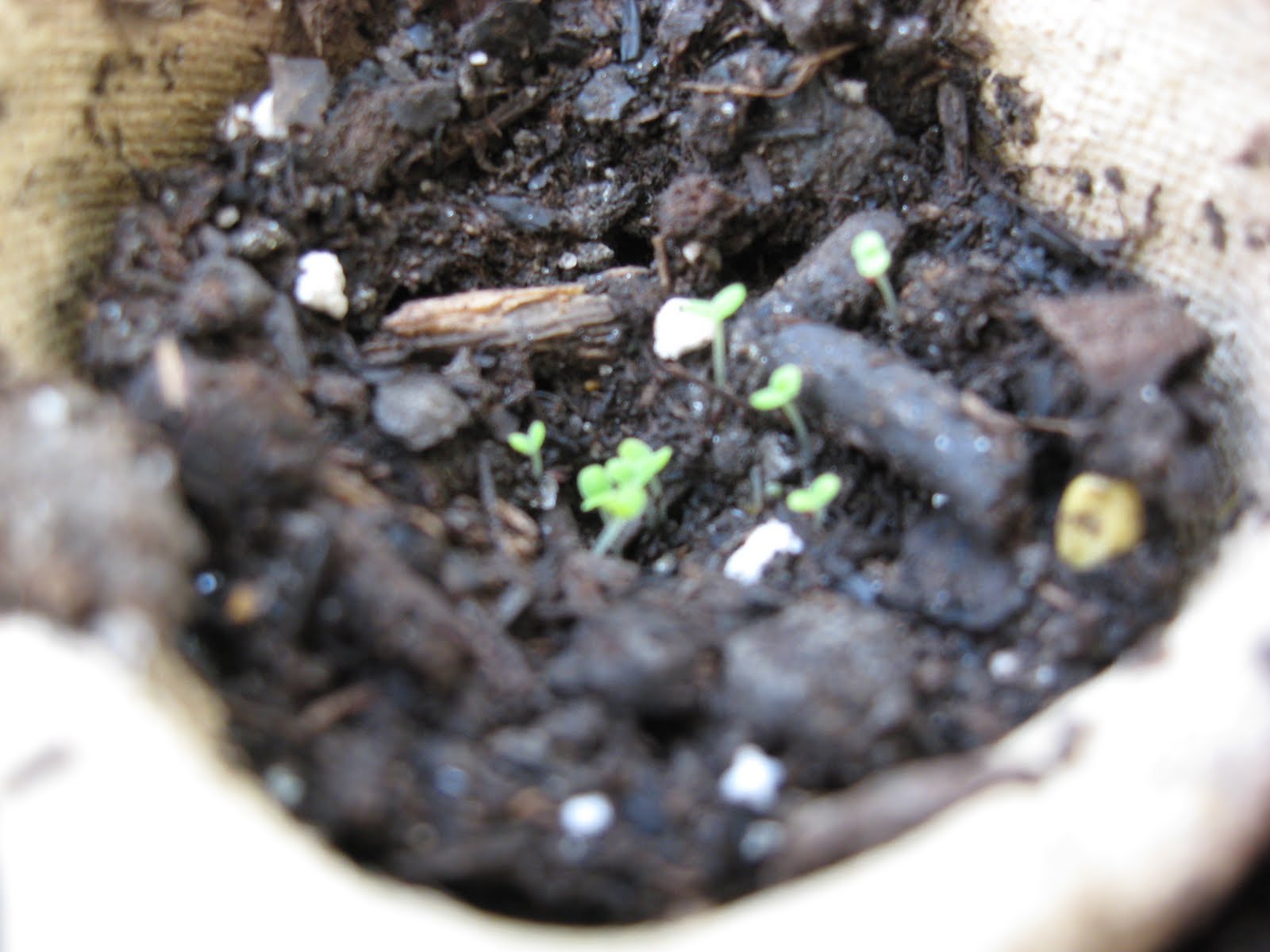
And these are the cherry tomatoes! I'm so glad those are growing, because they're the ones I want most. No green happening yet in the big tomato area, or the chives.

Now I need to figure out how big I'm supposed to let them get before I transplant them to a bigger pot.
Wednesday, March 09, 2011
Yellow

No, nobody peed on our walls. We finally finished priming the red room - it only took two coats with that high-hiding primer stuff - and we've moved on to choosing a paint color. We know we want yellow, but there is a lot of variation in the "yellow" category, and things can go banana or Big Bird pretty quickly.
The one on the left is Canary, which turned out retina-searingly bright. So that one's a no. And the one on the right is Natural Straw, which ended up a lot more brown on the wall than on the sample card. I want a pale, not-bright yellow for those walls, something sunny and happy. I'm planning on setting up my new (as yet unused) sewing machine in there and making it into a crafts and stuff room. It has a door I can close to keep the cats out, which is a huge plus!
Going through the pile of sample cards we brought home and taking into account the fact that one we liked was too bright and one was too brown, we think we've found a new contender. So, back to Home Depot (or was it Lowes? Who has Behr paint?) for another tiny sample jar so we can see how it looks before we commit to it. Hopefully, updates and a yellow room by the end of the weekend!
Monday, March 07, 2011
Bird Feeder
Wanting both to see pretty birds in the garden, and to torment the kitties by having pretty birds congregating just out of their reach, I bought a bird feeder. I stayed cheap because I didn't want to make a huge investment - I got a small suet feeder and a block of suet/nuts/berries to put inside it. "Songbird mix", I believe it said. I also bought a small shepherd's hook to plant in the ground, because there's nothing suitable in that area from which to hang a bird feeder.

It looked cute, but no birds were attracted to it the first day. I suppose it takes an adventurous bird to investigate a new food source and bring back news to his friends, and the explorers were otherwise occupied that day. And then it poured the next day, keeping every living critter huddled in its shelter. Including me. This morning, I woke up to find my feeder had been vandalized. Not surprising, really, but disappointing.
 At least my total investment was under $20. Those squirrels will do some serious acrobatics to get at bird feeders, but I can't afford those neat motorized ones that spin the squirrel off into space. Maybe I'll look for a plastic feeder I can stick to the window with suction cups, instead, and hope that the local squirrels don't have rocket packs.
Sunday, March 06, 2011
Some interesting and important facts about blood
March is Red Cross month, and the hospital is hosting a blood drive (as we do every two months). As the blood bank's donor recruiter, I have to try and raise awareness and interest and get people to sign up to donate blood. This time, the hospital management is getting more involved because it coincides with a new charity campaign they're running, so I was asked to write up some "interesting facts about blood" that could be used in our weekly newsletter and on our intranet page. I want to share them with you, and also encourage you to try donating blood - it only hurts a little bit and you're helping save lives. I see the other side of it all the time, with patients desperately needing blood and platelet transfusions, so I can tell you, it's important. Blood can't be manufactured (yet - research is making strides) and needs to come from donors. Plus, you get cookies!
Blood Facts
The very first blood transfusions were back in the 1600s and involved transfusing small volumes of sheep's or calf's blood to sick patients. Because the blood was from a different species, the patients often had fatal reactions to the transfusions. By the 1800s human blood was being transfused to patients, but because the blood would clot quickly outside of the body, the blood could not be stored, and had to be transferred directly from donor to recipient. Many of these transfusions still resulted in the death of the patient, until blood groups were discovered by the Austrian scientist Karl Landsteiner in 1901. After that point, blood types could be matched for transfusions, greatly reducing the risks.
In the 1930s, The Soviet Union was the first country to establish a system of blood banks, after discoveries showing that adding anticoagulant to blood allowed it to be stored outside the body, in refrigerators. The first American hospital blood bank was established at Cook County Hospital in Chicago in 1936. Blood was stored in glass bottles until plastic blood storage bags were developed in the 1950s.
There are four main blood types, defined by what type of antigen (carbohydrate and protein structure) is present on the red blood cells. There are two antigens: A and B. Those with the A antigen are type A, and those with the B antigen are type B. If your red cells have both, you will be type AB, and if you have neither, you are type O. The blood types are genetically determined and their distribution varies in different populations, but in the United States, approximately 44% of people are type O, 42% are type A, 10% are type B, and the rarest blood type is type AB, in only 4% of the population. Whether you are, say, O-positive or O-negative, will depend on whether you have the Rh factor, another important antigen on red blood cells. If it is present, then your type is "positive", and if it is absent, your type is "negative". Only 15% of individuals are Rh-negative.
The immune system of an Rh-negative mother who is carrying an Rh-positive fetus can become sensitized to the Rh factor, which can create problems with subsequent pregnancies. The result is babies being born with hemolytic disease of the newborn (HDN), where the baby's red cells are being destroyed by the mother's antibodies, leading to dangerously high bilirubin levels and anemia. In 1968, the first dose of "RhoGAM" was given to an Rh-negative pregnant woman - this product can prevent the mother's immune system from being sensitized, greatly reducing the risk of HDN. Blood and Rh typing is now part of normal prenatal care, so that all Rh-negative pregnant women can receive a protective dose of RhoGAM or an equivalent product.
Before blood can be transfused, the recipient will have a "type and screen" done. This test takes approximately 45 minutes and will determine the patient's blood type and check the patient's plasma for any antibodies to other blood groups. This ensures that the patient is receiving compatible blood. The "crossmatch" is when a drop of donor cells is mixed with the recipient's plasma to check for compatibility. If it is compatible, the donor unit is labeled for the patient and can be transfused.
In emergency situations, a blood bank can issue uncrossmatched blood. This happens when the patient's history and blood type are unknown and there is no time for testing before the blood is needed. In these cases, O-negative blood is always given, because it is compatible in recipients of any blood type. Once the patient's sample is available for testing, the blood bank will complete the work and make sure that no unexpected antibodies are present, and then prepare more units for transfusion that are of the same blood type as the patient.
Most blood collected in donor centers today is split into its components, rather than being transfused as whole blood. This is more efficient, because patients receive only the components they need, and one donation can save more than one life. Blood is spun in a centrifuge and separated into red cells and plasma. Red cells are used to treat anemia and blood loss, and help improve oxygen delivery to the tissues. Plasma contains clotting factors and is often used to treat hemorrhage and to quickly reverse the effect of anticoagulant medications. Other elements that can be separated from a blood donation are platelets, which are necessary for clotting, and cryoprecipitate, which is a concentrate of clotting factors.
Platelets are small fragments in the blood whose role is to form clots and stop bleeding. The average lifespan of platelets is only a few days before they lose their potency, which means that they are unable to be stored for an extended period. This is why platelets are often in short supply - donations must be steady to ensure their availability.
The American Association of Blood Banks estimates that 9.5 million volunteers donate blood each year, 20 percent of whom are first time donors. According to the 2007 National Blood Collection and Utilization Report about 16 million units of whole blood and red blood cells were donated in the United States in 2006. Every day in the U.S., approximately 40,000 units of blood are required in hospitals and emergency treatment facilities for patients with cancer and other diseases, for organ transplant recipients, and to help save the lives of accident/trauma victims.
Hopefully I've taught you something today... As usual, I welcome questions about the lab and the blood bank! For questions relating specifically to blood donation, like eligibility criteria or what to expect when you arrive, I'll refer you to the Red Cross website for first-time donors. Please consider donation, or at the very least spreading the word and asking someone else to donate. It does make a difference.
Saturday, March 05, 2011
What's for Dinner - Rice with Onions
Sick of mashed potatoes, and bored with plain rice, I decided to ask Mr. Bittman for advice. The purple rice (not its official cookbook name) from How To Cook Everything was a delicious hit, so it was worth going back to his rice section and looking at my options.
I selected the clearly and austerely named "Rice with onions". No mistaking what you're getting in a recipe like that! I halved it because it makes a ton of rice, but I'm giving you the full recipe here in case you're feeding a horde.
Rice With Onions
3 to 4 cups thinly-sliced onions
4 tablespoons butter (or olive oil - but I used butter)
1 1/2 cups long grain rice
Salt and pepper to taste
1/2 tsp dried thyme
3 cups warm chicken, beef, or vegetable stock
You put the onions in the pot you'll be making the rice in, and cook them, covered (don't add butter or oil yet) until they're dried out a little but not brown. It takes about 10 minutes. Add the butter and thyme, toss the onions to coat in the melted butter, then add the rice and toss to coat it with the butter too. Add salt and pepper. Stir in the broth and let cook for 30-45 minutes, covered, stirring every now and then, until the liquid is absorbed and the rice is soft.

This was so good that I'm not sure I'll ever be able to make boring white rice again. Incredibly creamy, with a little sweetness from the onions, and a lot of flavor from the thyme. I think I forgot to half the thyme, actually, so you could increase the amount and it won't hurt you.
Subscribe to:
Posts (Atom)